As we have seen, endless didactic materials may be used in CLIL lessons. However, like in any other lesson, in most cases we will have to make some adaptations according to our goals, the lessons' contents and above all: our students' needs.
Apart from the general pedagogic criteria, some aspects gain special importance regarding CLIL lessons.
- LANGUAGE SCAFFOLDING: Many texts will need to be simplified, especially at lower developmental levels or when dealing with L2 beginners.
- Starting by unblocking some vocabulary is a good way to start: On the one hand we make sure that they can access the desired language, but also we can aim at a longer-term resource: We can build a wider vocabulary bank gathering expressions from all our lessons, for our students to use it after them, in varied real contexts.
- Extra visual support also helps them to deal with contents in a foreign language: pictures, underlined info, letters sizes, colours.
- Schemes or mind maps can also be handed out to highlight the main ideas.
- HOTS: Most didactic resources suggest tasks involving LOTS such as answering basic questions, reproducing information or completing guided exercises. If we want to move some HOTS we will have to include more challenging proposals.
- COLLABORATIVE WORK: Whenever it is possible we will adapt activities to be carried out in pairs or groups and activate the target language and develop their social and emotional abilities.
- ACTION-ORIENTED APPROACH: Not only intellectual written activities interest us: Hands-on moments should be added to promote manual and creative skills. Have students moving freely around the class will improve their awareness and sense of responsibility when performing within common spaces, instead of always operating from their own desk. ITC tools are a shortcut to ensure that even shier learners are involved in interactive activities and are not passive.
- OPEN RESPONSES: Suggesting open proposals give learners the chance to find the solution to a task by different means or to come out with different solutions, fostering their entrepreneurship skills as well as their divergent and critical thinking.
- ORGANIZERS: Since we are adapting materials to have learners involved in more complex processes, we will need to offer them guidelines to order their ideas/ actions.
- INTEGRATED COMMUNICATIVE SKILLS: We will do our best to add an oral component to written tasks and vice-versa, so that mediation and interaction are also assured.
- PROVIDING CONTEXT: If the material selected does not make it clear enough, we will adapt it for our students to connect the skills practised with their daily lives. A grabbing clear introduction by means of images, role-play, setting... or a little discussion, explanation, presentation at the end. Anything that help them -especially younger students- to value their implication and to get a real sense of achievement.
Let's set a context to get practical: We are designing a Science-English lesson for Spanish students aged 10-11. The integrated aim of the lesson is: "To describe and predict living beings reactions to their environment".
Together, we are going to adapt the text below to make it more suitable for a CLIL lesson, according to the criteria above.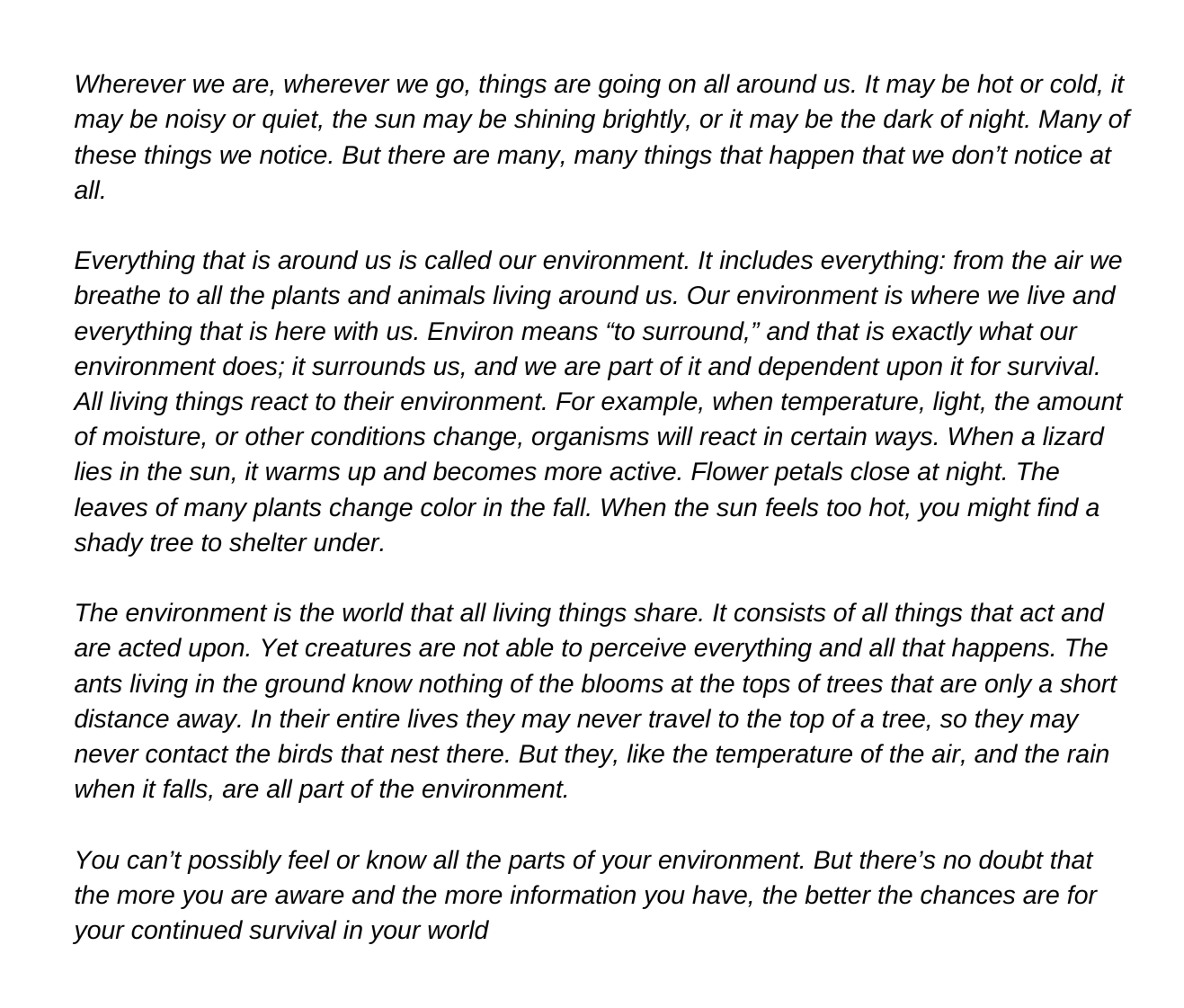
✔First, we are going to scaffold language by applying the three strategies mentioned: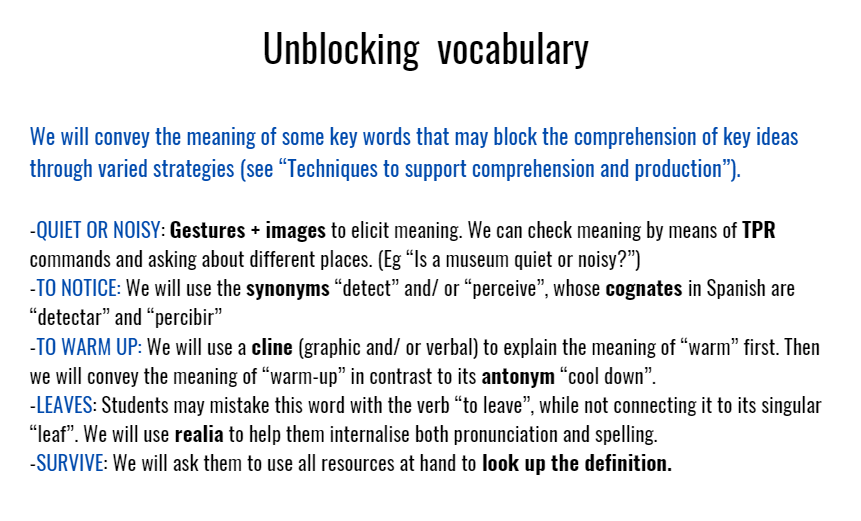
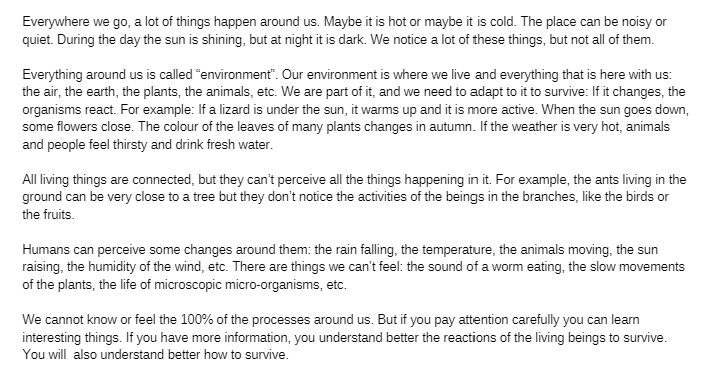
✔Now, we are going to simplify the text. Work together in pairs or small groups. Finally, check if you took similar decisions. Here is one possibility:
✔Finally, we can support comprehension providing visual resources. Suggest your own ideas. Here are some too:
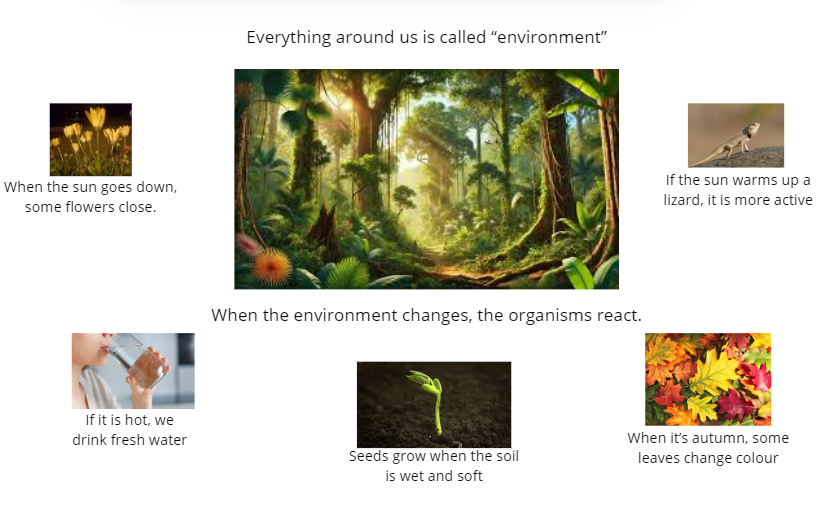
✔It's time now to come up with some HOTS- designed to admit OPEN RESPONSES
- Summarise the living beings in the text and their reactions to changes in their environment.
- Explain why reacting to our environment is important (you can predict what will happen to the living beings in the text if they don't react to the situations you summarised).
- Design a mind map with examples of humans' reactions to their environment.
- Do living beings react ONLY to immediate changes around them?
- Do you think a flower's color or smell can save a plant's life?
- Do you think flowers have the same colour or smell as 3000 years ago?
- Draw a comic where humans develop a superpower to better adapt to a planet without rain.
✔ Collaborative tasks/ action-oriented approach to the text:
- ROLE PLAY TO PRACTICE THE LANGUAGE: Zero conditionals (with "when") to talk about general truths: some students take the role of human groups in different historical moments, others are journalists traveling to those moments. We provide both groups with organizers to use the target language, after having spotted model sentences in the text:
JOURNALISTS: What do you do if/ when...+ subject + present simple + ?
TRIBES: If/when +previous subject & action , we + present simple.
- ANIMALS/PLANTS PROTECTION SQUAD: We will bring seeds or sprouts of plants or animals that can be effectively looked after by our students (chickens, silk warms, hamsters, fish) and we organize groups to be responsible for their well-being.
They will first anticipate what will happen according to our actions. eg "If we forget to bring mulberry leaves, worms will starve", "if we maintain pots wet, seeds won't get dry", etc
They can also use the language to organize the roles: "If we write turns to feed the fish, we will all be responsible for their health", "If we establish a measure, fish won't be deprived or overfed".
✔ Integrating communicative skills