FUNCTIONAL LANGUAGE: REAL EXPRESSIONS IN REAL CONTEXTS
From the Communicative Approach in languages teaching, grammar and vocabulary are not learning goals themselves, they are tools "at service" of reaching the communicative competence.
Furthermore, in a CLIL lesson the aim will be never to teach "grammar".
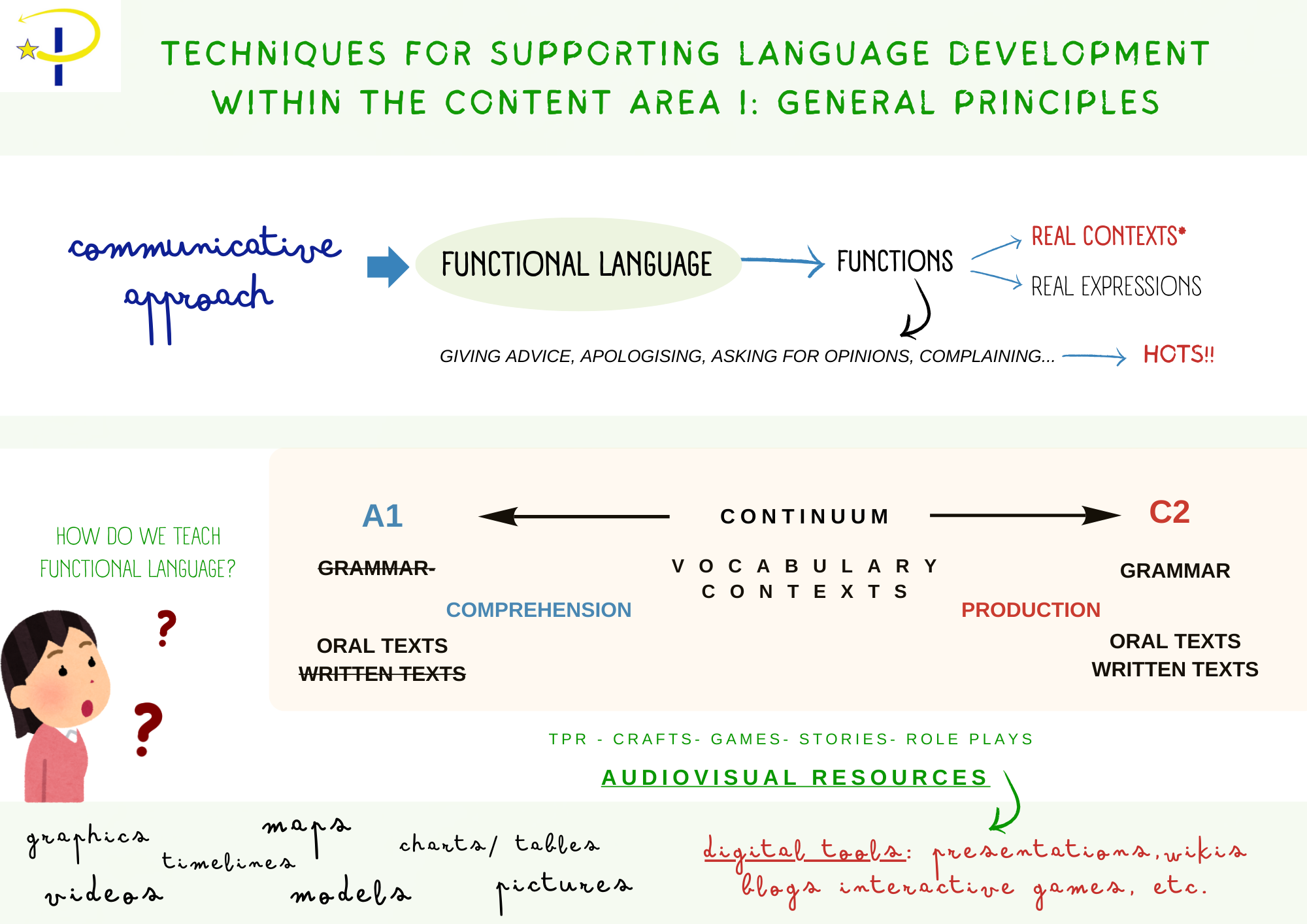
The focus is always on FUNCTIONAL LANGUAGE: common useful expressions that can be used in specific situations to solve daily problems.
In our case: everyday language but also academic language necessary to understand and convey concepts related to maths, geography, arts, etc. and to be able to complete specific tasks within those areas, such as interpreting a chart, draw a plane, calculate a surface, follow a healthy diet, compare landscapes, etc.
However, the way to take our students there cannot differ from the way foreign languages are taught. So, here are the basic principles we will follow to support the acquisition of the L2 within the content areas.
The main idea is to understand the acquisition of the L2 as a continuum, with several different extremes. We will move from:
- ORAL to WRITTEN language.
- COMPREHENSION to PRODUCTION.
- WORDS or SIMPLE PHRASES to COMPLEX TEXTS
- Plain VOCABULARY to COMPLEX GRAMMAR
...Being VOCABULARY IN CONTEXT the core element, as me have mentioned:
So... how do we teach this kind of language?
We are seeing this in detail, but to begin with: using the same logic as with any other content.
The younger the learners are, the more physical, visual, tangible and dynamic the means must be: handicrafts, songs, games, drawings and very short simple texts always supported with audiovisual resources.
As we move forward to higher educational levels, we will introduce varied and complex types of academic texts and audiovisual resources such as graphics, maps, timelines, etc.
No matter the developmental stage, all current digital tools are a priceless resource to keep younger and older learners engaged in active meaningful ways and help them understand and produce bits of the target language.