
SKIMMING AND SCANNING: COMPREHENSION TECHNIQUES
When language learners face a new oral or written text, they usually get anxious for not understanding everything.
It is very important to insist on the fact that that's not necessary at all. Drilling Skim and Scan they will get immediately rewarded and gain confidence.
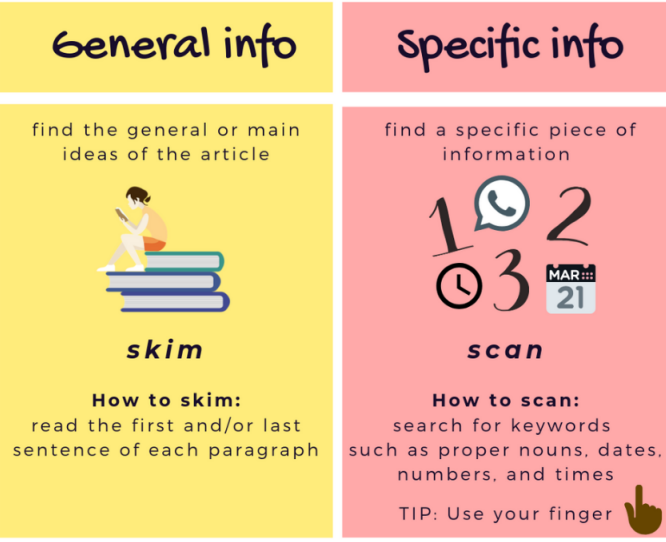
Let's start with Skim:
We Skim texts quite often in our daily lives when we want to know what a text is about, without paying attention to details. Can you think of any of these common situations?
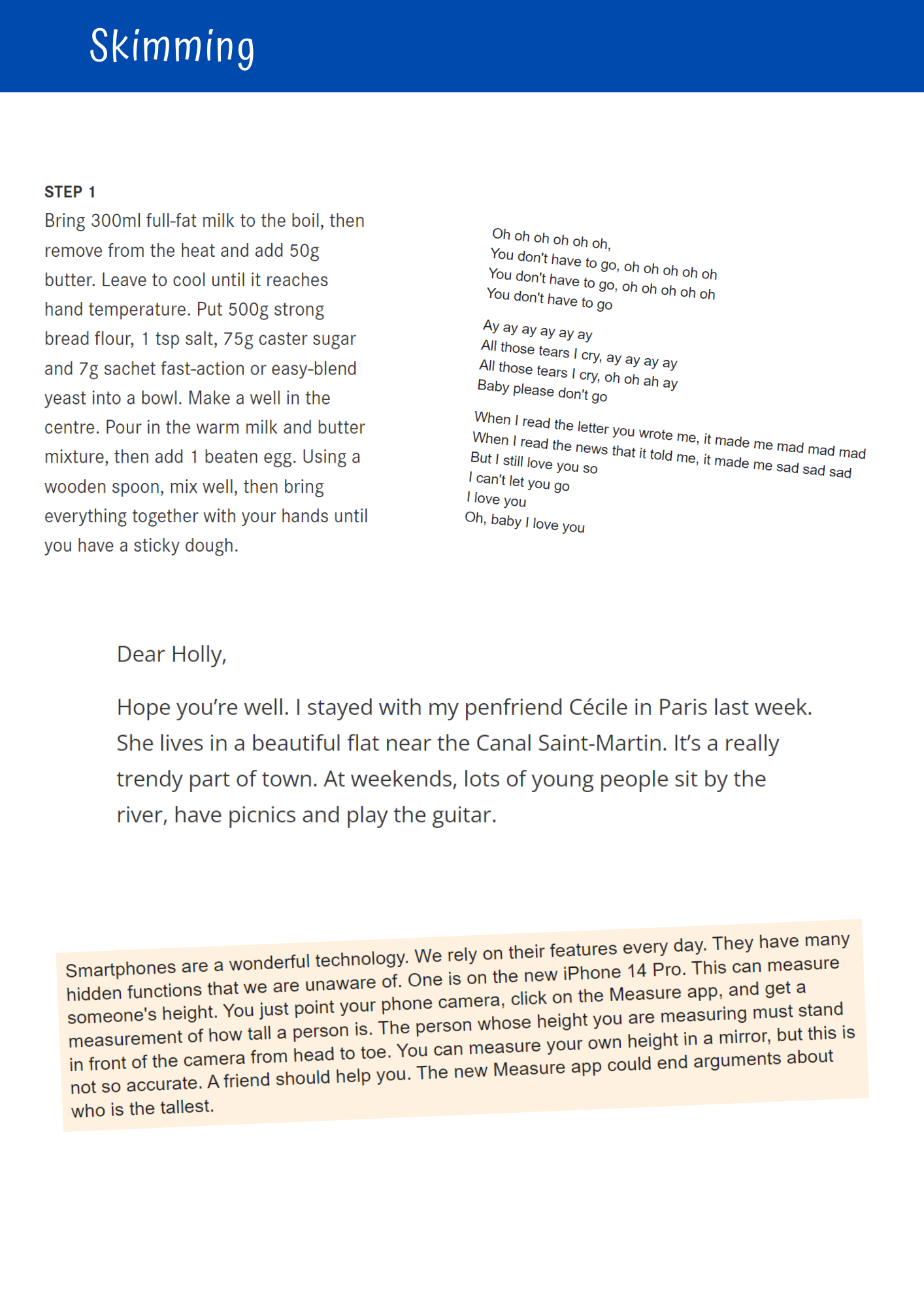
The way to drill this ability is to ask learners to take a quick glance at the text WITHOUT TRYING TO UNDERSTAND IT, just to guess what kind of text it is and what is it about.
Here is a sample of what we can show them. We can make it as a game, giving them just a few seconds to answer:
Scanning a text
We scan a text to find quick specific information in it. Maybe we are looking for a nice recipe to cook and we enter several websites to swiftly check the ingredients or if the recipe is gluten-free without paying attention to the rest of it.
To drill Scan, we will show a text and ask learners to spot the information required in the minimum possible time. They use to find it challenging and fun and get fully involved.
Here is an example:
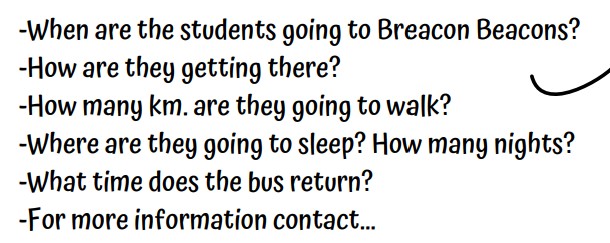
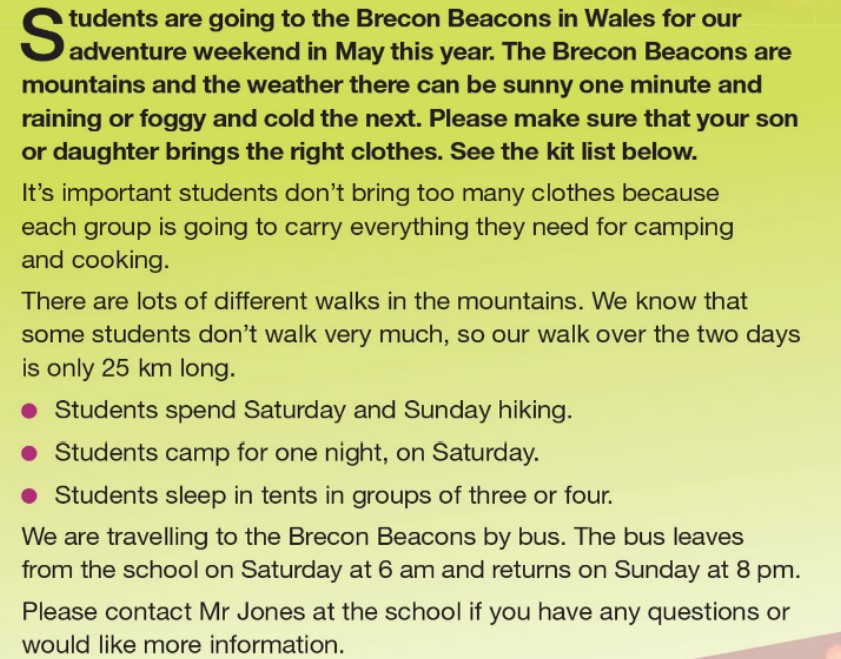
This is a text about a school trip written by a teacher to the parents. Find this info as fast as you can:
After that, we can help them be aware of some things:
- When we read, and especially when we listen, we need to focus our attention on what we need to know and forget about the rest.
- Real situations when we naturally do this. eg. in a station, where we only need to pay attention to what time OUR TRAIN leaves, or from which platform, ignoring all the rest of announcements and noise.
- This is a skill we all have, but can improve with practice.
- When asked about a date, our brain and eyes quickly looked for numbers, days of the week, etc. without too much effort.
This is how we make students relaxed about a task they rather often find tricky, effortful and tedious: reading a text. It's actually a scaffolding strategy which, for many young learners means the world and make them change their mind forever.
ADVANTAGES OF SKIM AND SCAN.
After skimming and scanning a text with this kind of "games", they are well familiar with it, have experienced a positive touch with it and are far more confident and calm to approach a more detailed reading/ listening even not knowing a few words or expressions.
It also helps them to infer the meaning of new vocabulary feeling more at ease than simply facing the raw text and start looking up unknown words.
Above all, as we mentioned: they will fell comfortable with "not understanding" and less withdrawn when it comes to longer or more complex texts.
Scaffolds for detailed comprehension:
- Infer the meaning of new vocabulary by context.
- Spot and record the main ideas: phrase, "title", drawings, scheme...
- Spot the words that answer a question: underline, highlight.
- Organizers: Match info found with info given.
Reading between lines
This skill is mostly employed within the languages areas: understanding the writer's feelings, intentions, figurative or indirect messages,etc. and mostly with older students, but...
... It's surprising and amazing to check how very young learners can develop their ability to grasp subtleties and to come up with creative interpretations of poems, songs, etc.
Having students practising this kind of reading-guessing allows them to build up divergent thinking and think outside the box.